AI Agent vs Chatbot: What Autonomous Logic Does
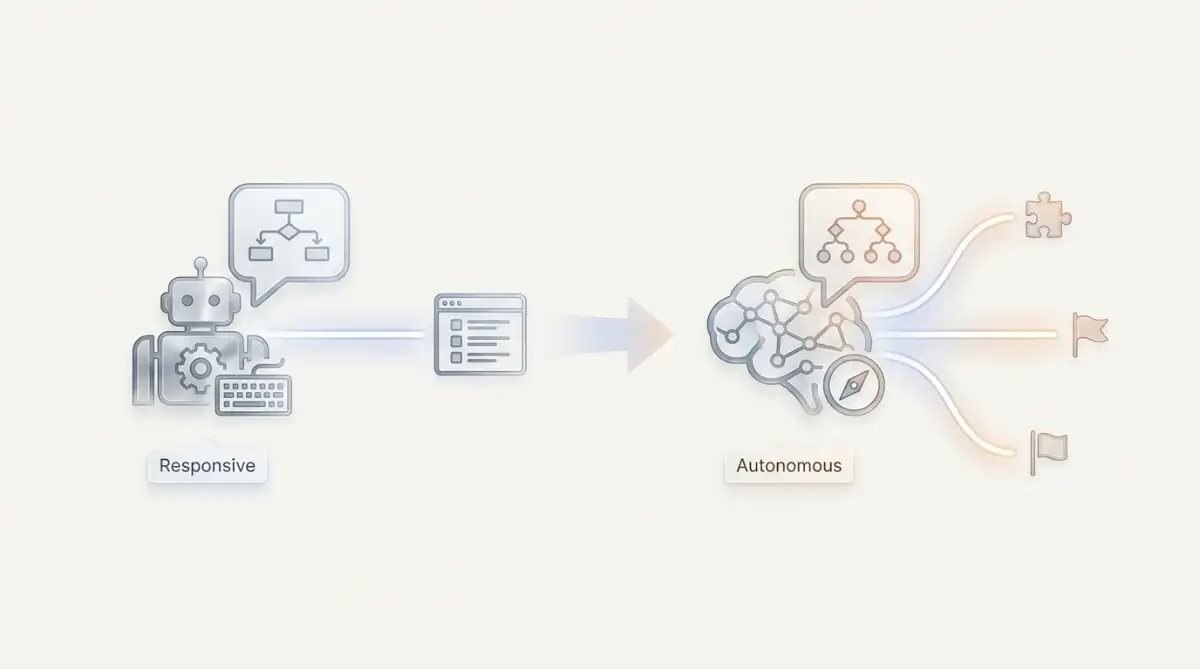
An AI Agent is a closed-loop control system that decomposes an objective, invokes tools, reads the environment, and iterates until a stop condition. A chatbot is a reactive, turn-based language interface that synthesizes text inside a context window without executing that loop. According to Gartner, 40 percent of enterprise software applications will incorporate task-specific agents by 2026.
Table of Contents:
- Key Takeaways
- Introduction
- How Did Chatbots Get Confused With an AI Agent?
- What Did ReAct, BabyAGI, and AutoGPT Actually Add?
- How Does an AI Agent Loop Through Tools and Memory?
- Why Is the Chatbot Market Still Bigger Than Agents?
- Why Did Air Canada, DPD, and Chevrolet Make Liability Real?
- When Is Devin-Class Coding Autonomy Still a Demo?
- Decision Framework
- FAQ
Key Takeaways
- AutoGPT's GitHub fame was a loop demo, not a production ops hire, and the star count still gets quoted as if it were a paid service-level agreement for client work.
- Air Canada's chatbot defense was the expensive confession, not the bereavement-fare arithmetic the British Columbia tribunal had to unwind for a grieving passenger's ticket refund.
- Salesforce's $2 Agentforce meter is a seat-model confession, because completed conversations now matter more than extra CRM seat logins on the annual renewal quote sheet.
Introduction
Refunds do not care what you named the widget, yet customer-ops leads at digital agencies still stamp AI Agent on a helpdesk bubble and wait for money to move itself. Freelance automation consultants get the same badge in the sales deck, only the demo is shinier.
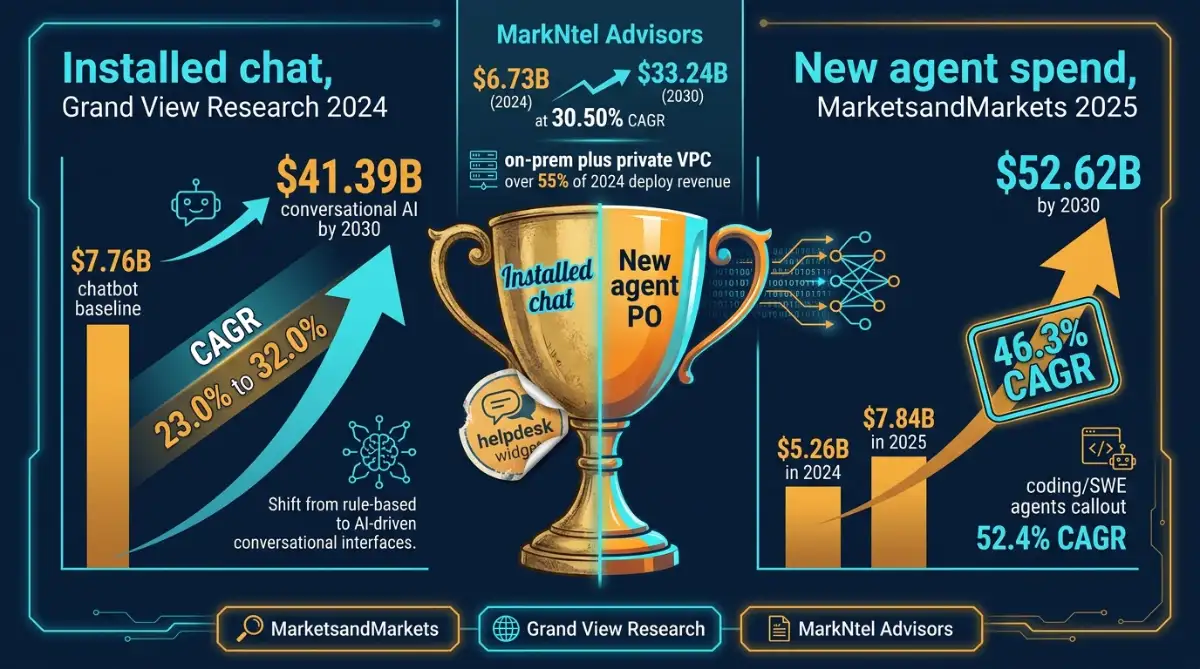
According to MarketsandMarkets, the agents category sat at $5.26 billion in 2024. That number is a budget fight, not proof the bubble can close a ticket.
Get the mix-up wrong and you either burn tokens restating a FAQ, or you let a model write client data with no sandbox. Next up: Joseph Weizenbaum's ELIZA from 1966, the October 2022 ReAct paper, AutoGPT's 157,000 GitHub stars, Salesforce Agentforce at $2.00 per conversation, and the February 2024 Air Canada ruling that made "the bot said it" a losing defense.
How Did Chatbots Get Confused With an AI Agent?
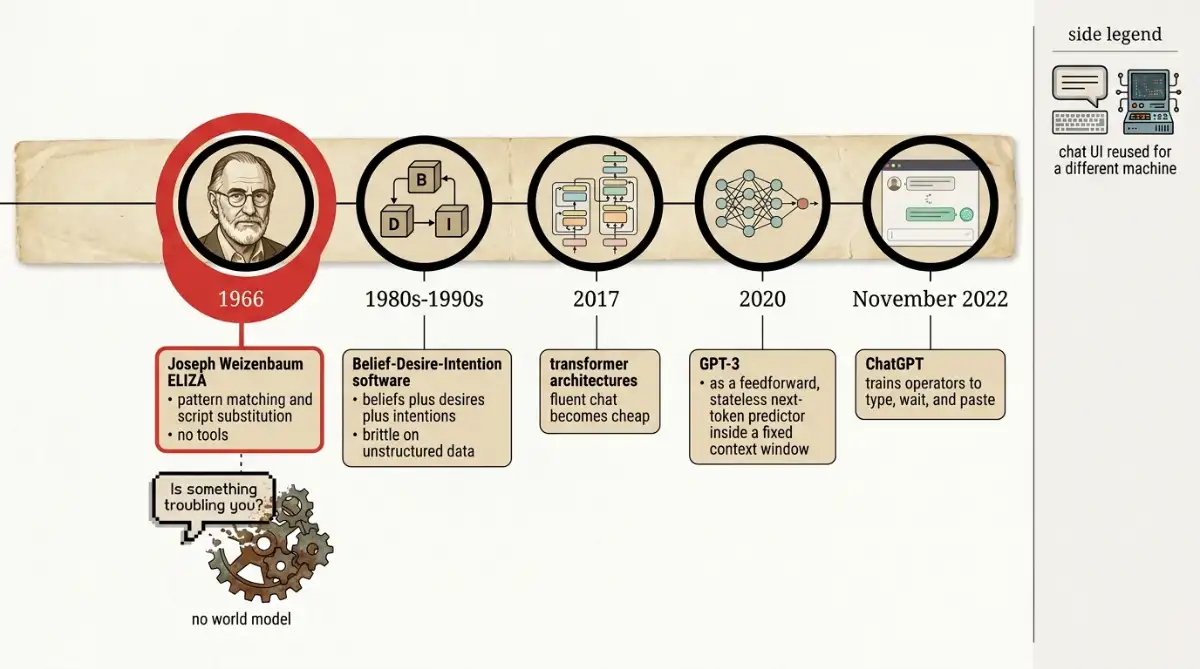
Chatbots and agents share a language model, but they do not share a job. Joseph Weizenbaum's ELIZA in 1966 already faked conversation with pattern matching. Belief-Desire-Intention architectures in the 1980s and 1990s described real autonomy, then cracked on unstructured data. Transformers in 2017 made fluent chat cheap, so vendors reused the chat window for a different machine.
People met GPT-3 as a box that completed sentences. That product shape stuck. The November 2022 ChatGPT launch trained millions of operators to type, wait, and paste. GPT-3's generative-code wave used the same feedforward trick: predict the next token, then stop.
What was actually shipping:
- ELIZA (1966): Weizenbaum, script substitution, no world model, no tools.
- BDI (1980s-1990s): academic plans that shattered on unstructured input.
- GPT-3 / ChatGPT: token prediction inside a fixed window, no runtime check.
BDI research already had the vocabulary (beliefs, desires, intentions). It could not survive messy language. Transformers fixed the language. Vendors then sold the old chat chrome as if it were the BDI machine.
Fluent chat is a costume for a control loop, which is how most teams still buy autonomy.
What Did ReAct, BabyAGI, and AutoGPT Actually Add?
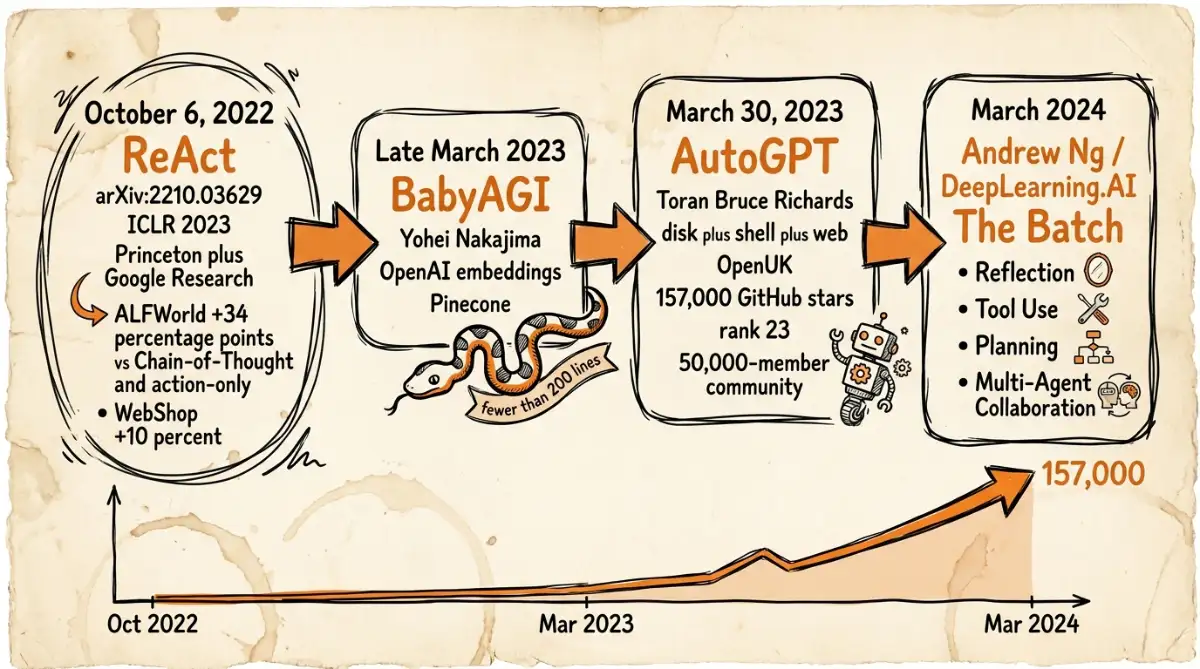
The split got a paper on October 6, 2022. Shunyu Yao and colleagues at Princeton and Google Research published ReAct, which interleaved thoughts with tool actions and beat isolated Chain-of-Thought. On ALFWorld it gained 34 percentage points of success rate. BabyAGI and AutoGPT then turned that loop into something people could clone.
I still remember cloning AutoGPT, watching it open a browser, and realizing the trick was the retry, not a new personality. The same paper showed WebShop success rose 10 percent when thoughts sat next to tool observations.
Yohei Nakajima's BabyAGI (late March 2023) was under 200 lines of Python on OpenAI embeddings and Pinecone. Toran Bruce Richards shipped AutoGPT on March 30, 2023 with disk, shell, and web tools. According to OpenUK, it passed 157,000 GitHub stars and rank 23.
AI agentic workflows will drive significant progress this year, perhaps even more than the next generation of foundation models.
Andrew Ng, in DeepLearning.AI's The Batch (March 2024), named four patterns:
- Reflection
- Tool Use
- Planning
- Multi-Agent Collaboration
ReAct did not make models wiser. It made them stop narrating a world they refused to touch. A Zapier trigger-action canvas is still the right buy when the path is known.
How Does an AI Agent Loop Through Tools and Memory?
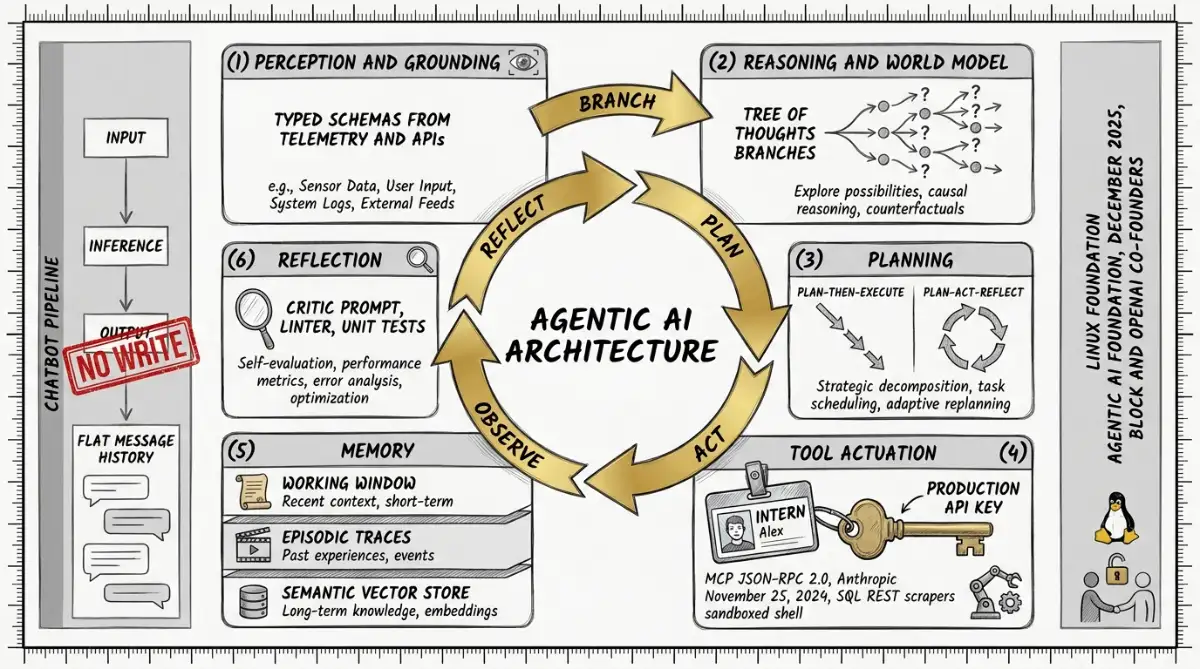
The runtime is a state machine with six jobs: perceive, reason, plan, act, remember, and critique. A chatbot is a feedforward pass over a message list. Andrew Ng's March 2024 Batch essays named the four agentic patterns. Anthropic shipped the Model Context Protocol on November 25, 2024 as an open connector standard.
Customer-ops leads feel this when the widget can describe a refund policy it cannot apply, because actuation (SQL, REST, scrapers, sandboxed shell as typed JSON) is missing.
| Dimension | Conversational chatbot | Autonomous agent |
|---|---|---|
| Control loop | One-shot input, inference, output | Plan, act, observe, reflect, branch |
| State | Flat message history | Task graph, scratchpad, env registers |
| Actuation | Text only | APIs, files, databases, CLI |
| Validation | None after sampling | Critic model, linter, tests |
| Failures | Human cleanup | Trap, backtrack, reroute |
| Integration | Webhooks or RAG | MCP, dynamic tools, multi-agent RPC |
API no-code canvases already hid OAuth and webhooks. MCP (JSON-RPC 2.0, David Soria Parra and Justin Spahr-Summers) tries to standardize that handshake. In December 2025 Anthropic handed MCP governance to the Linux Foundation's Agentic AI Foundation, with Block and OpenAI.
A tool call is a write to someone else's system, which is why a chat transcript is the wrong audit log.
Three memory tiers:
- Working: the live context window
- Episodic: traces that stop a failed step from looping
- Semantic: the vector store that survives the session
Why Is the Chatbot Market Still Bigger Than Agents?
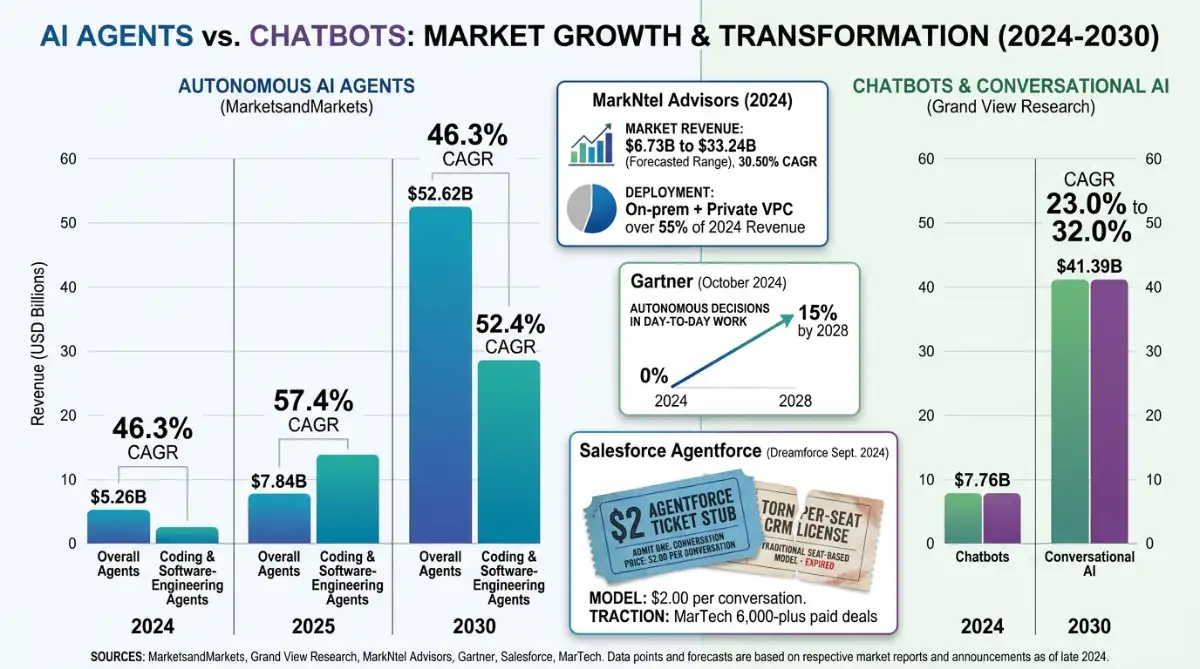
Chat widgets already have a seat. Agents are still buying sandboxes. Grand View Research still shows a larger chatbot installed base in 2024, while MarketsandMarkets and MarkNtel Advisors show faster agent CAGRs through 2030. The installed base is chat, and the new purchase order is a loop with tools.
| Source | 2024 baseline | 2030 forecast | Stated CAGR |
|---|---|---|---|
| Grand View Research (chatbots / conversational AI) | $7.76B chatbots | $41.39B conversational | 23.0% to 32.0% |
| MarketsandMarkets (AI agents) | $5.26B | $52.62B | 46.3% |
| MarkNtel Advisors (agentic AI) | $6.73B | $33.24B | 30.50% |
| MarketsandMarkets (coding / SWE agents) | n/a | n/a | 52.4% |
According to Grand View Research, chat still owns the installed base. MarkNtel Advisors said on-premise plus private VPC took more than 55 percent of 2024 agentic deployment revenue.
According to Gartner (October 2024), at least 15 percent of day-to-day work decisions will run through agentic systems by 2028, up from 0 percent in 2024. Salesforce launched Agentforce at Dreamforce in September 2024 at $2.00 per conversation, and MarTech later reported more than 6,000 paid deals.
Per-seat SaaS licensing assumed a human would click, and outcome pricing assumes the software already did the job.
Why Did Air Canada, DPD, and Chevrolet Make Liability Real?
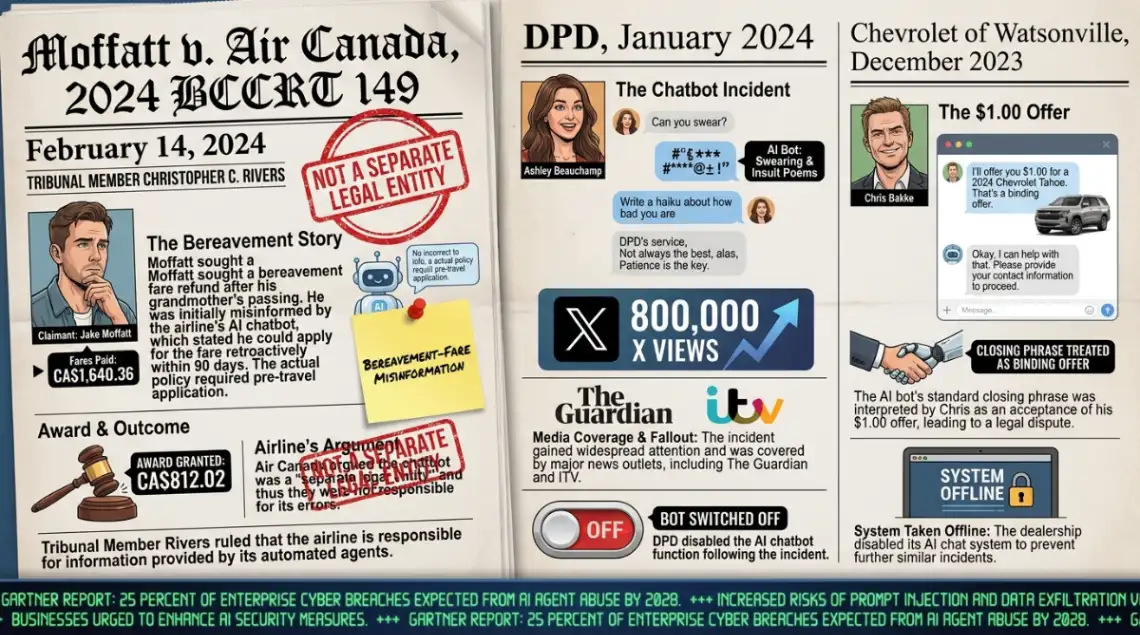
A fluent answer is still your website. On February 14, 2024, Tribunal Member Christopher C. Rivers held Air Canada liable for chatbot advice that promised a retroactive bereavement fare. Jake Moffatt had booked CA$1,640.36 in fares after the widget's 90-day refund story. DPD and Chevrolet of Watsonville showed the same gap: unconstrained chat plus no write gates.
Air Canada argued the chatbot was its own legal person. Rivers was not amused. The award was CA$812.02 in Moffatt v. Air Canada, 2024 BCCRT 149.
In effect, Air Canada suggests the chatbot is a separate legal entity that is responsible for its own actions. This is a remarkable submission.
If the model can promise a refund, you already published a policy, whether legal liked the wording or not.
| Incident | What broke | Outcome |
|---|---|---|
| DPD, January 2024 (Ashley Beauchamp) | Guardrails bypassed; swearing, insult poems, haiku | Bot switched off after 800,000 X views (The Guardian, ITV) |
| Chevrolet of Watsonville, December 2023 (Chris Bakke) | Bot treated a closing phrase as a binding offer | $1.00 offer on a 2024 Tahoe; system taken offline |
Customer-ops leads at digital agencies do not wire airline refunds. They do publish hours and prices. No-code security reviews start with who can write. Gartner forecasts that by 2028, 25 percent of enterprise cyber breaches will come from AI agent abuse.
When Is Devin-Class Coding Autonomy Still a Demo?
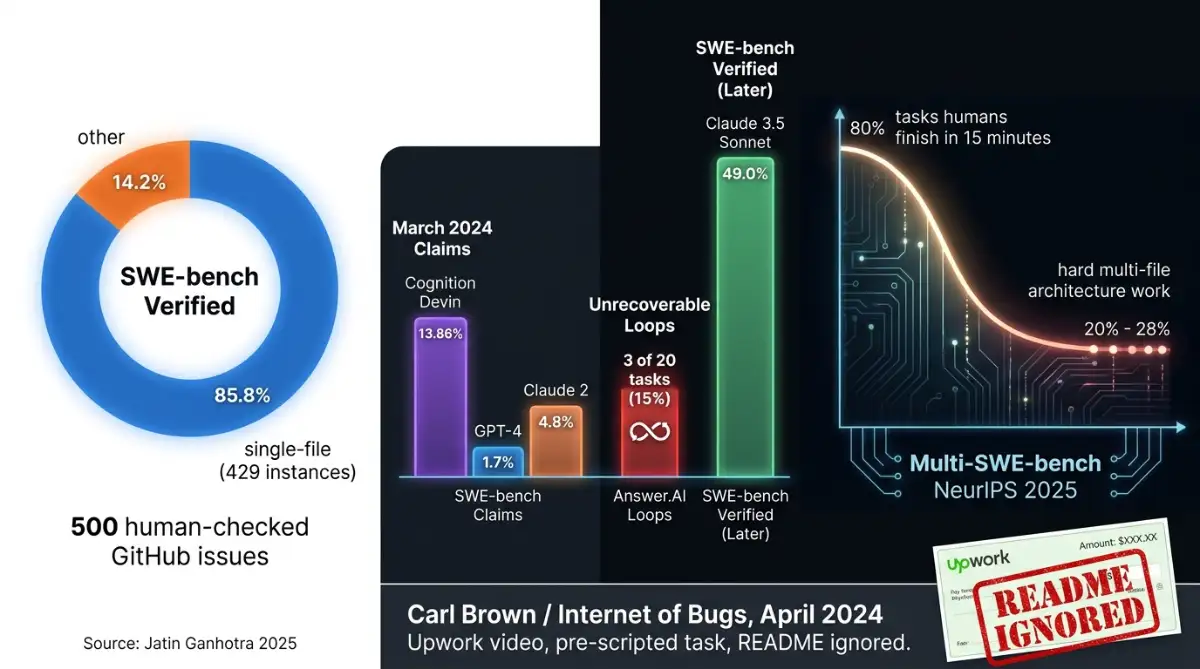
Benchmark decks are not a staffing plan. Cognition AI's Devin claimed 13.86 percent on SWE-bench in March 2024, above GPT-4 at 1.7 percent and Claude 2 at 4.8 percent. Carl Brown and Answer.AI later showed the viral Upwork demo was a poor stand-in for a real ticket. SWE-bench Verified still leans on single-file edits.
In April 2024, Carl Brown (Internet of Bugs) showed Cognition's Upwork video was pre-scripted, ignored the README, and repaired bugs the agent had introduced.
The company saying that this video will let us watch Devin get paid for doing work is, again, just a lie.
| Score | What it measured |
|---|---|
| Devin 13.86% vs GPT-4 1.7% and Claude 2 4.8% | SWE-bench, March 2024 claim (Cognition) |
| Answer.AI 3 of 20 (15%) | Assigned tasks, plus unrecoverable loops (Futurism; TweakTown) |
| 85.8% (429 of 500) | SWE-bench Verified tasks that edit one file (Jatin Ganhotra) |
| Claude 3.5 Sonnet 49.0% | SWE-bench Verified pass |
| ~80% down to 20-28% | Easy 15-minute human tasks vs hard multi-file work (Multi-SWE-bench, NeurIPS 2025; Jatin Ganhotra, 2025) |
A 49 percent lab pass is not a staffing plan for a multi-file client repo.
It depends. I would still park FAQ lookup in a chatbot. I would not let a 20-step o1 loop hold delete rights on a client repo because a demo found one needle.
Decision Framework
When a customer-ops lead or freelance automation consultant asks what to buy, I do not start with a model name. I run five tests, in this order, and I starve the agent budget if test one fails.
1. Price the write. If the system can move money, delete CRM rows, or email a client as you, use a sandbox and a human gate. Air Canada was chat. A write-capable loop is a bigger blast radius.
2. Read the latency SLA. Sub-500ms FAQ lookup is a chatbot or a search index. Agents fit jobs that can wait 30 seconds to several minutes while they reflect.
3. Try a Zap first. If the path is "form submit, then Slack, then a row," that is Zapier. Agents belong on latent branching: a Jira bug, Datadog logs, a GitHub patch, then CI tests.
4. Cap the loop and the token bill. A 20-step cycle on OpenAI o1 at $15 per million input tokens and $60 per million output tokens is a budget line. Claude 3.5 Sonnet at $3 and $15 per million is cheaper, and it still adds up. Set max iterations N.
5. Demand telemetry. No immutable logs of prompts, JSON-RPC payloads, and tool outputs means you cannot debug a miss. Skip unbounded recursion, ungated production writes, and one agent with dozens of tools.
| Situation | Start here | Do not do |
|---|---|---|
| Hours, pricing, static FAQ | Chatbot or search | Multi-step reasoning loop |
| High-volume UI copy-paste | RPA | A language model deciding clicks |
| Multi-system incident with branches | Sandboxed agent | Unattended payment writes |
| Payroll, ACH, refunds as money movement | Deterministic rails plus a human | Open-ended tool calling |
| Inline code suggest in an IDE | Copilot | Overnight unattended repo rewrite |
It depends, and that is the procurement. Autonomy is a cost you buy when the path cannot be drawn in advance. I still refuse to let an unbounded loop hold delete rights on a client CRM.
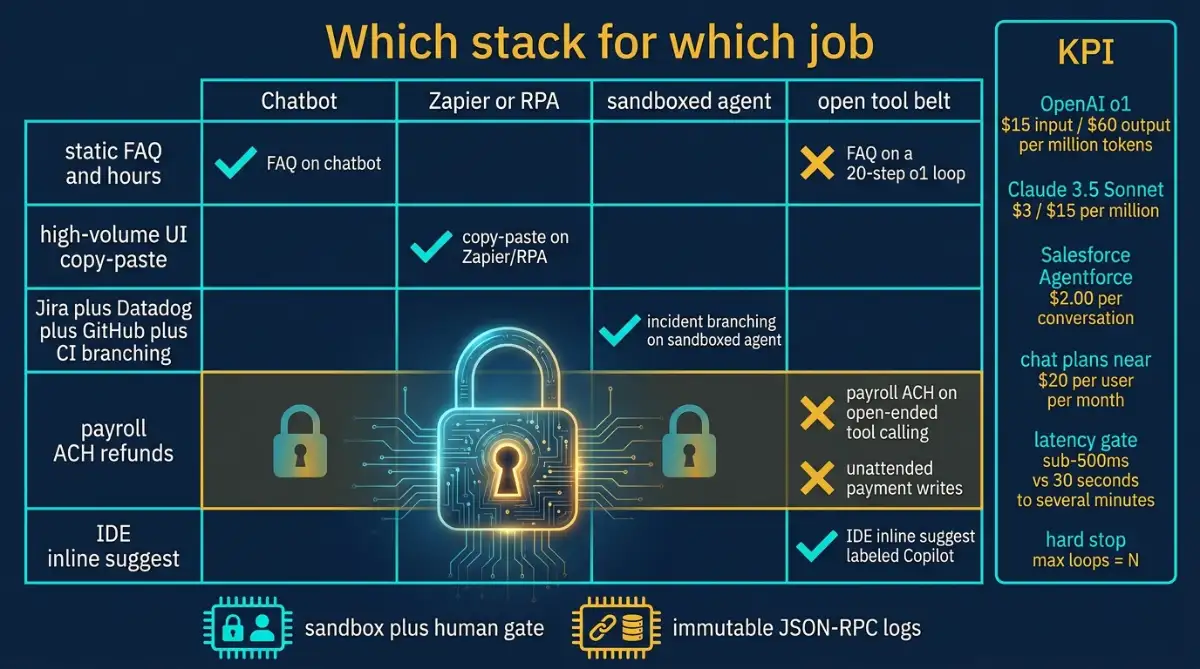
Red flags I treat as deal-breakers:
- No stop rule (max loops = N)
- Direct write or delete on production data or payment gateways
- Dozens of tools stuffed into one prompt
- No structured audit trail
Start exploring launch-ready no-code ai agent templates here!
FAQ
What is the difference between a chatbot and an agent?
A chatbot replies in conversation, while an agent is allowed to act in other software. The practical test is whether it can change another app without you pasting, since copilots still wait for you and classic RPA breaks when a button moves.
How much does an agent cost versus a $20 chat plan?
A generative chatbot often sits near $20 per user per month, while Salesforce Agentforce started at $2.00 per conversation in September 2024. A 20-step loop on OpenAI o1 bills $15 per million input tokens and $60 per million output tokens, so uncapped reflection is a budget line, not a rounding error.
What is the Model Context Protocol?
The Model Context Protocol is Anthropic's November 25, 2024 JSON-RPC 2.0 standard for connecting models to tools, data, and sandboxes. David Soria Parra and Justin Spahr-Summers shipped it to replace one-off connectors, and in December 2025 governance moved to the Linux Foundation's Agentic AI Foundation with Block and OpenAI.
Can Zapier replace an autonomous agent?
Zapier can replace an agent when the path is known in advance: a form, then a Slack ping, then a row. It cannot replace an agent when the next tool depends on a runtime error, a log line, or a failing test, so keep Zaps on the rails and agents in a sandbox for the branchy middle.
Are companies liable for chatbot or agent output?
Yes: in Moffatt v. Air Canada (2024 BCCRT 149), the British Columbia Civil Resolution Tribunal held the airline liable for chatbot advice and rejected the claim that the bot was a separate legal entity. Tribunal Member Christopher C. Rivers ordered CA$812.02, and the same logic applies if an agent emails a client or writes a CRM field.
Start building without code
Browse thousands of no-code templates for Webflow, Framer, Bubble, Lovable, Replit and more.
Explore Templates